The Image of Reality
When we perceive something, we structure the world according to an image. And this image is always our own. Every image that we form of the world arises at the boundaries of our ability to think. We investigate, explore, discover, structure, and explain to ourselves the complexity of relations in the world according to causality, circumstance, requirements, and our capacity to comprehend.
We discern connections, bind them to systems and concepts, and declare them to be valid. We construct our image of the world on the basis of certain underlying assumptions. On the one hand, these assumptions are vulnerable to lapsing into rigidity by clinging inextricably to familiar thought constructs.
On the other hand, they face the possibility of total dissolution; one staggers about in a reality that can no longer be grasped, as one’s assumptions concerning the world lose their validity at momentous speed, while there no longer exists any framework to provide one’s context or location.
You can’t change human nature.
Concepts provide security and create orientation. They serve a basic human need by not only allowing us to locate ourselves within the world, but also to perceive ourselves as part of the world in the first place. Without having an image of reality, it would simply not exist for us.
The validity of perceived reality essentially revolves around the freedom of every individual, determined by their thinking and their ability, to change that reality.
But how do we deal with this freedom and the limits of our thinking? And where do we learn to become familiar with our own thinking process?
The following holds for all cognitions and thoughts, present and previous: Neither is there a fixed quantity of this knowledge nor is our process of learning ever complete. Knowledge and insight must always be construed as a process.
This is because all knowledge is based on previous knowledge. Only on the basis of our current state of knowledge can we confront our questions concerning life and its circumstances. This is true for qualitative as well as for quantitative knowledge. Our worldview is in a state of flux – constantly emerging and passing away – and this is and remains a process on a personal, societal, cultural, global, and universal level.
»
Who would we be,
if we are not that what we think? «
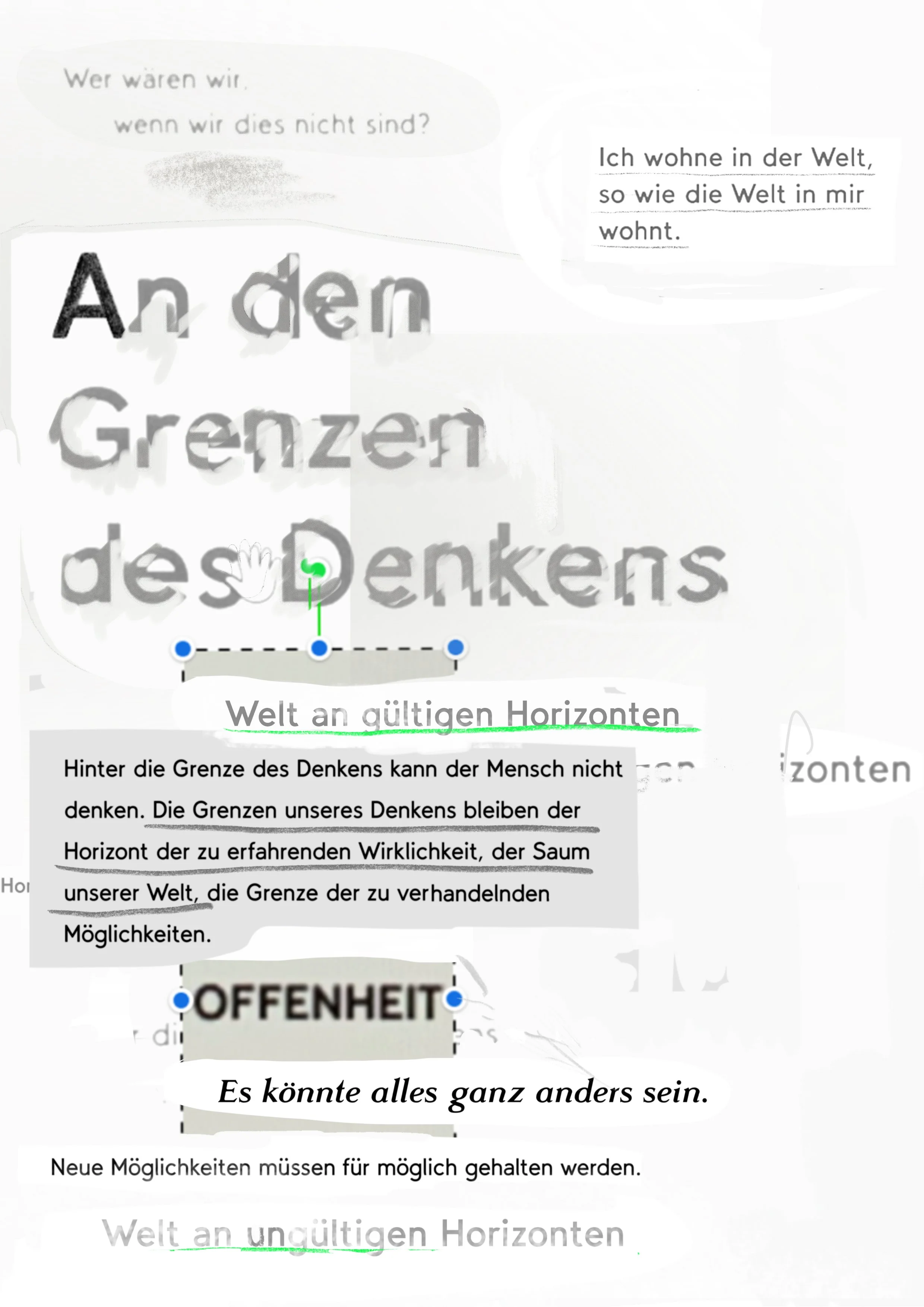
New possibilities must be considered possible.
Every journey of discovery in a new realm of experience begins with the assumption that discovery or development is possible and can take place. Without giving oneself the permission to concede that there may be something new and unknown beyond the borders of one’s present thought constructs and horizon of experience, it is not possible to open up to new opportunities.
You must allow yourself to question established fundamental assumptions.
This willingness to call everything into question also poses a risk – namely that one is able or willing to accept that some or possibly all of one’s previous apperceptions, based on accepted thought structures, themselves having up until now shaped our inner and external views of the world, may prove to be inadequate or obsolete.
I have to accept the limitations of my knowledge and thereby permit long-established concepts and structures to change, dissipate, or be rejected altogether. There must be a willingness to voluntarily submit to a state of uncertainty. Impulses such as curiosity, the spirit of discovery, the urge to explore, the joy of experimentation, and the playful desire to explore new possibilities are just some of the guiding principles that can intrinsically motivate change.
Similarly, a rethinking, a “questioning” of familiar patterns of thought and action, can have its origin in necessity or force of circumstances.
»
When do we change?
When we have to. «
The challenge to make a change often only occurs when we face situations in which our deeply internalized imperatives, those long-accepted assumptions about how reality “should be” or how we “must behave” in the world, come into conflict with someone else’s assumptions and conceptual constructs. Driven by our existential need to establish and maintain connections with others—to be in harmony with other people as well as with the interactions and movements of the world around us—such conflicts offer a strong impulse to change, or at least light the spark that engenders a desire for transformation.
The etymology of the German word for need or necessity—Notwendigkeit (Not = need, distress; Wendung = to turn)—clearly reveals this situation. Out of need or distress comes the necessity to turn things around. We reach a point at which our familiar picture of reality is no longer tenable or serviceable, and can no longer suffice as a secure foundation. Our trusted edifice of ideas, which has provided us with a safe environment to live out the long-standing and well-rehearsed processes and routines of our everyday reality, can suddenly emerge as a dysfunctional structure whose boundaries prevent or restrict the unfolding potential for development and encounter.
The fact is that the more solid the structures are, the longer they take to dissolve.
/ Real work is a process.
To enter a new space means to leave the old one, or to accept the respective effort and confrontation required to extend spaces beyond their present borders in order to expand them. This is a plain fact.
»
… except that situations do not always follow one another in clear succession, but often there is a happening profoundly twofold, confusedly entangled. «
—Martin Buber, I and Thou
As much as we may strive for order and hierarchy in our lives so as to create the security we hold necessary to define our positions in the world, we also need boundaries to provide us with a solid foothold, even though we must eventually tear them down in order to develop ourselves. No state of affairs, no thought ever conceived, and no assumption ever made about the world, about you, or me, can make a claim to absolute validity or absolute truth.
The essence of life is change. So if we want to maintain change, it only makes sense to try and understand it.
Take, for example, the “great transformation,” a topic widely discussed today and a process that is sweeping through the global economic landscape. As a result of the rapid pace of technological progress, this restructuring has not only facilitated, but has also compelled the liberalization of public policies in all social systems with an unprecedented speed. We should not forget to keep in mind that this very change is in itself an elementary characteristic of universal design.
Change is not a sudden phenomenon, no matter how often it may take us by surprise. Of course, our human condition gives rise to the need for security. Yet, the more we allow ourselves to be lured into dependency on a domineering control mechanism as a result of this need, the greater the affect and surprise we experience upon encountering any manifestation of change or transformation.
Life is a highly complex and extremely dynamic system, while change and transformation are its core essence. As such, all physical and mental architectures are subject to the processes of becoming, growth, and maturing to higher level, as well as decay, regression to a lower level, decomposition and, destruction, including collision, explosion, and implosion.
As human beings, we are all fated at birth to a cycle of becoming, transformation, and passing away. Nothing here can escape from movement or being part of a process. No being is static, but must be conceived dynamically as subject to eternal change.
This must be internalized and integrated into the mental matrix with which we view any image of familiar reality, with which we view any (world) event. How we live and come to terms with our world is determined by our thinking.
We dwell in the world just as the world dwells in us.
The centrifugal forces of nascent and upcoming world processes – namely the processes of transformation and change fundamental to life itself – threaten to hurl each of us out of the center of our own universe. What we require in turn is a clear awareness of the realities of nature with respect to the dynamism of the world.
This growing awareness must embrace a multidimensional, holistic consideration of inner and outer life processes. It therefore includes in equal measure the previously mentioned individual, social, cultural, global, and universal principles of movement.
Perhaps we need to start in the realm of possibility. We thereby give ourselves the permission to view our image of reality as one of many in the kaleidoscope of circumstances.
The Image of Reality
[ I am space ]
In the beginning, there was chaos.
I am the order of all things,
through the essence of being alive.
In the narrow confines of known thought,
in the realms of possibility of the unknown.
Does not this remain my happiness
in hopeless profusion?